Questions to ask your cousin, the only witness from the other side.
Good questions to ask your cousin or an older cousin about the grandparents you share, your parents’ childhood and the family stories you only half know.

The word “cousin” comes, by way of Old French, from the Latin consobrinus, which originally meant the child of your mother’s sister. The Romans had a word for the relationship because they cared who was in it. The child of your mother’s sister was raised in a different house, by a different set of habits, but out of the same family. Later the word stretched to cover every relative a few steps away, and its edges blurred.
The blur matches how most of us treat cousins. We know they are family, we are fond of them, and we see them at weddings and funerals. We rarely ask them anything. If you are searching for questions to ask your cousin, you have probably noticed that a cousin holds something nobody else does, and that the chance to ask is not permanent.
This post explains what a cousin knows that your parents and siblings do not, what to ask an older cousin or one your own age, and how to film the conversation so the answers last.
What does a cousin know that nobody else does?
A first cousin shares a set of grandparents with you. On average you also share about 12.5 per cent of your DNA, which is the genetic version of the same fact. But the interesting overlap is not genetic. It is that you both knew the same two people, and you knew them differently.
Your grandmother was one person to you and another to your cousin. She may have been stricter with the children of the daughter who lived nearby and softer with those who visited once a year. She may have cooked different things at different houses, told different stories to different grandchildren, and kept her own opinions about each of her children. Each branch of a family sees the grandparents through a different window, and no one else is standing at your cousin’s.
This is the same effect that makes siblings remember the same childhood differently, applied one generation out. A sibling shared your house and so shares many of your blind spots. A cousin shares your grandparents but not your house, which makes the disagreements more informative. Where your memories match, you have probably found the stable facts. Where they differ, you have found something about the grandparent, or about your own branch of the family, that you could not have seen from inside it.
Why do cousins hold the other half of the family’s stories?
Family stories travel through parents. Your mother tells you what her side of the family did. Your father tells you what his did. Neither is likely to tell you in detail about the households of their brothers and sisters, because they are not telling it from the inside either.
Your cousins heard the stories of the other branch at the other branch’s dinner table. A story about the grandfather’s years away, or the farm sold, or the brothers who fell out, may have been told in one house and never in yours. If your parent has died, or never spoke much about their childhood, a cousin can fill a gap that no other living person can. I describe the general version of this problem in how to get a parent to talk about their past. A cousin offers a way around it.
There is a second reason, which has to do with time. Your aunts and uncles will go first, and the cousin who inherited the photographs, the letters or the Bible with names written inside the cover will often be the person who can still read them. A family’s documents tend to collect in one house, and it may not be yours.
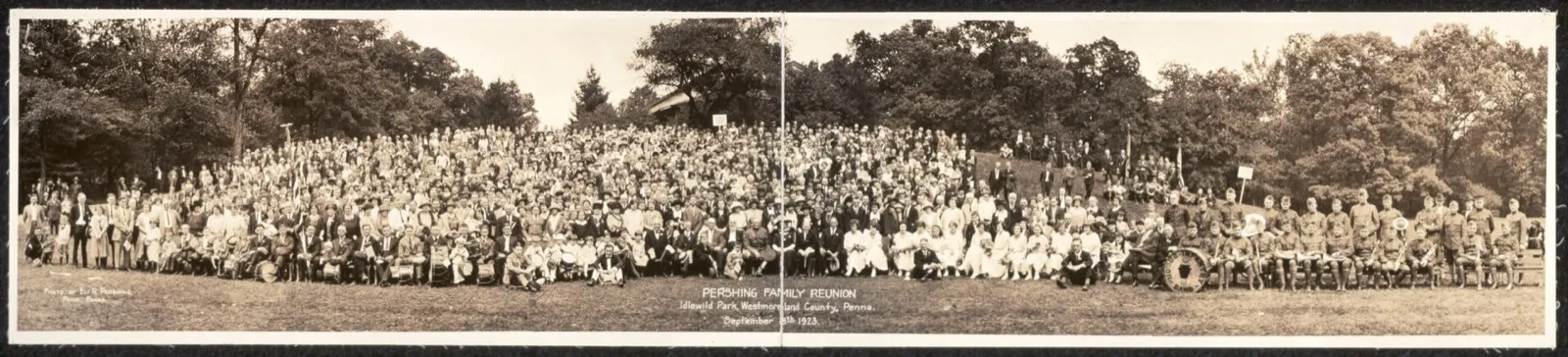 Pershing Family Reunion, Idlewild Park, Westmoreland County, Pennsylvania, 8 September 1923. John J. Pershing Collection, Library of Congress. Public domain.
What are good questions to ask your cousin?
Start with what you shared, because it is easy to talk about, and move toward what you did not. Group the questions by what you want to learn.
The grandparents, from the other side
- What is your earliest memory of Grandma and Grandpa?
- What was their house like when you visited? What did it smell like, and what were you allowed to touch?
- What did they cook, and who actually cooked it?
- Was there a room, a chair or a corner that was theirs alone?
- Were they different with you than with the other grandchildren? Did you ever notice?
Our parents when they were young
- What did your mother or father tell you about growing up in the house with my parent?
- Who was the favourite child, and did anyone say so?
- Was there a story the adults told when they thought the children were not listening?
- What did your parents think of mine? Did they ever disagree about it?
Family stories that only half survived
- What do you know about why we are not in touch with that branch of the family?
- Is there a family story you have heard that you think is not true?
- Whose photographs do you have? Do you know who is in them?
- Who in the family do you think had the most interesting life, and what do you know about it?
Growing up in the same family
- What did you think of my family when you were young? What did we look like from your house?
- What do you remember about the two of us as children?
- When did you first understand something about the family that you had not known before?
What the two of you can do now
- If we could record one thing about Grandma and Grandpa before the generation above us is gone, what should it be?
- Who else in the family should we ask?
- What do you want your children to know about our grandparents?
How should you ask an older cousin?
An older cousin is a particular opportunity. They are often the oldest grandchild, or close to it, which means they saw the grandparents when they were younger, in houses that no longer exist, with relatives who died before you were born. A cousin ten or fifteen years older than you may remember the grandparents at fifty, while you remember them at seventy.
The usual rules apply, and they apply more strongly with someone you know only a little. Ask open questions that begin with “what” or “tell me about”, and avoid questions that can be answered with a yes or no. My notes on open versus closed questions cover the reasoning. Ask them to describe a place before asking them what happened there, because the memory of a kitchen or a veranda tends to open the story that goes with it.
Say plainly why you are asking: you are recording what the family remembers while the people who remember it are still here, and you think they know things you do not. Most people respond well to being the one who knows.
Why do the disagreements matter more than the agreements?
Two cousins will not agree about everything, and that is where the material is. If one of you remembers the grandfather as gentle and the other as stern, both statements can be true. Perhaps he was one thing in a good year and another in a bad one. Perhaps he treated his own children differently from his grandchildren. Perhaps you each saw one side of a person who had many.
Do not settle these disagreements. Record them. A future family member watching the video will learn more from two honest and different accounts than from one smooth one. When you hear a difference, ask, “Why do you think we remember it differently?” and leave the silence open. The answer is often a fact about the family that neither of you had put into words.
How do you film a conversation with a cousin?
A cousin is easier to film than a parent or grandparent because you are equals, and the conversation tends to be relaxed. That is also the risk: it can drift into the sort of chat that feels good and leaves nothing behind. Three things help.
Choose a setting with a purpose. A family reunion works, as I discuss in family reunion ideas people will actually remember, but only if you set aside a quiet corner. A walk, a long drive or a kitchen table works better.
Bring something to react to. An old photograph is the best prompt there is. Ask who is in it, where it was taken and what was happening that day. Cousins often recognise faces that you cannot, and the answers are the part you cannot recover later.
Film both of you. You are not only interviewing, you are a witness yourself. Put the phone on a stack of books so that both of you are in the frame, and answer your own questions too. The recording is more useful to a later generation if it shows two grandchildren comparing notes, because that is what they will do in turn.
For the practical side of light and sound, see how to film an interview at home. For the questions you could ask the generation above you at the same visit, there are lists for your aunt and your uncle.
Why film it at all?
A cousin conversation is one of the few ways to record two versions of the same people. Writing down your own recollections gets you one. Filming two cousins talking gets you the way each remembers, the places where they correct each other, and the laughter that marks a story everybody in the family has told before. Since 2020 I have filmed more than a hundred life stories, and I would rather have a recording with an honest correction in it than one without.
The people who will watch it are not only you. They are your children and your cousins’ children, who share your grandparents’ ancestry and will not have heard their voices. A video of two cousins describing the same grandmother is the closest they will get to meeting her.
A phone and a quiet hour are enough. The Everyone app can offer one question at a time and save each answer as a short video, but any camera will do.
Start with one message
You do not need a reunion or a recording schedule. Send your cousin a message this week and ask one question, such as “What do you remember most about Grandma’s kitchen?” Then ask whether you could film the answer next time you see them. The cousin who answers may hold half of what your family knows about the people you both came from, and the other half is in your own memory, waiting to be compared.